USDA Loan Foreclosure and Bankruptcy: Collections, Charge-offs, and Recovery Guide
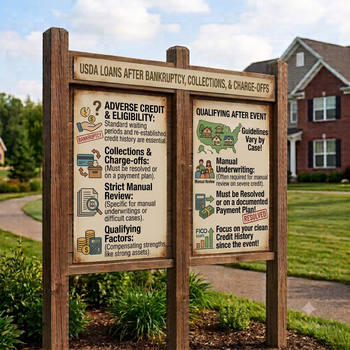 If you've experienced USDA loan foreclosure, bankruptcy, collections, charge-offs, or tax liens, you might think homeownership is out of reach. But USDA loans after bankruptcy are different. Both USDA Direct and USDA Guarantee will work with borrowers who have past financial issues, as long as you've had time to recover and can demonstrate financial stability since. Understanding the impact of bankruptcy on credit and how to navigate credit challenges is the first step toward financial rehabilitation strategies and rebuilding credit after bankruptcy.
The key word is "since." A bankruptcy from 5 years ago with clean history since? Both programs might work. A charge-off from last year? Likely automatic decline. Unpaid collections? Both require payment before closing. Bankruptcy assistance programs, debt relief options, and financial counseling services can help you prepare.
This article breaks down how bankruptcy, collections, charge-offs, USDA loan foreclosure, and tax liens affect your USDA eligibility for both Direct and Guarantee programs. The differences between them matter. We'll cover qualifying for USDA loans, credit score improvement, loan eligibility after bankruptcy, understanding charge-offs, handling collections effectively, and the USDA loan application process.
Before diving in, you may want to check current USDA loan calculator estimates to see what monthly payments might look like in your situation. It's also helpful to review USDA credit score requirements and USDA income requirements to understand the baseline.
USDA Direct vs. Guarantee: Negative Items Comparison
| Negative Item | USDA Direct | USDA Guarantee |
|---|---|---|
| Bankruptcy (Chapter 7) | 2+ years if discharged | 3+ years if discharged |
| Bankruptcy (Chapter 13) | 1 year into plan with history of on-time payments (case-by-case) | 3+ years if discharged or completed |
| Foreclosure | 3+ years (case-by-case) | 3+ years (stricter) |
| Collections (unpaid) | Must be paid before closing | Must be paid before closing |
| Collections (paid) | Acceptable, especially if older | Required to be paid; older collections preferred |
| Charge-off (unpaid) | Can be acceptable with explanation (case-by-case) | Typically not acceptable |
| Charge-off (paid/settled) | Acceptable with explanation | Might be acceptable if settled and older |
| Tax Lien (unpaid) | Must be resolved before closing | Must be resolved before closing |
| Tax Lien (satisfied/released) | Acceptable after release | Acceptable after release |
| Judgment (unpaid) | Must be resolved or payment plan set up | Must be resolved before closing |
| Late Payments (30-60 days, recent) | Case-by-case if 12+ months old | Not acceptable in last 12 months |
| Late Payments (60+ days, recent) | Not acceptable in last 24 months | Not acceptable in last 24 months |
For a broader overview of USDA loan options, visit our USDA Loans PA page. You can also compare USDA vs. FHA loans to see how guidelines differ.
Part 1: USDA Direct and Negative Items
Bankruptcy (Chapter 7)
USDA Direct allows applications 2+ years after discharge. This is significantly more forgiving than USDA Guarantee (which requires 3+ years).
What the underwriter wants: Proof that the bankruptcy was caused by something beyond your control (job loss, medical emergency, divorce) and evidence that your financial situation has stabilized. If you've had stable employment and on-time payments for two years since discharge, you're a good candidate for qualifying for USDA loans.
What you'll need: Written explanation of what caused the bankruptcy. Documentation of current employment and income. Credit report showing on-time payments since discharge. The stronger your recent financial recovery, the better your chances.
Age of bankruptcy matters. A bankruptcy discharged 5+ years ago with clean history since is highly approvable. A bankruptcy discharged 2 years ago with spotty payment history since? Tougher sell.
Bankruptcy (Chapter 13)
USDA Direct is very flexible on Chapter 13. You can apply while still in the bankruptcy plan if you've made on-time payments for at least 12 months and have your trustee's approval. This is unique - most federal programs won't even consider active Chapter 13 borrowers. Loan modification assistance and financial counseling services can help you prepare.
What you need: Proof of 12+ months of on-time plan payments. Written approval from your bankruptcy trustee. Proof that the bankruptcy trustee will not object to your home purchase. Your disposable income (per your plan) must be manageable alongside the new mortgage payment.
If you're discharged from Chapter 13, you're treated similar to Chapter 7 - must be 2+ years post-discharge.
Foreclosure
USDA Direct requires 3+ years since the USDA loan foreclosure was completed. This is the same as USDA Guarantee, but USDA Direct is more flexible on the explanation and recovery story.
The underwriter will want to know what caused the foreclosure. Job loss? Medical hardship? Divorce? If you have a clear explanation and can show that your situation has stabilized since, you're approvable. Mortgage forbearance plans and affordable repayment solutions may have been options before foreclosure.
Key: You need to be 3 full years out and have clean payment history during those three years. If you had the foreclosure 3.5 years ago but missed payments 18 months ago, that recent delinquency is a bigger problem than the foreclosure.
Collections (Unpaid)
USDA Direct requires all unpaid collections to be paid in full before closing. Period. No exceptions. You cannot close with active, unpaid collections on your credit report. Handling collections effectively and understanding how collections affect loans is critical.
What to do: If you have collections, contact the creditor and negotiate a settlement. Collection agency negotiations often result in agencies accepting 50-70% of the debt to settle. Pay it off or settle it before applying. The payment must be documented and the account marked as "paid" on your credit report. Debt settlement negotiations can reduce your total obligation.
Collections (Paid)
Once a collection is paid, USDA Direct is forgiving. The paid collection is still on your credit report and still hurts your credit score, but the underwriter recognizes you've made it right.
Age helps: A collection paid 3+ years ago? Easily approved. A collection paid 6 months ago? Still acceptable with other compensating factors. The more time between payment and application, the better.
Multiple paid collections? Each one is individually assessed, but if you've paid them all and been clean since, you're approvable on USDA Direct.
Charge-off (Unpaid)
USDA Direct is case-by-case on unpaid charge-offs. Some underwriters will approve if you have compensating factors (excellent recent history, stable income, low debt). Others will require payment or settlement before approval. Understanding charge-offs and their impact is key.
Best strategy: Settle the unpaid charge-off before applying. Call the creditor or collection agency (if assigned) and negotiate a settlement. Once settled and documented, it becomes a "paid charge-off" which is far more acceptable. Charge-off recovery tactics and debt settlement negotiations are essential tools.
If you cannot settle and have strong compensating factors (3+ years of perfect payments since, stable employment, low debt ratios), USDA Direct might approve anyway. But don't count on it.
Charge-off (Paid or Settled)
USDA Direct readily accepts paid or settled charge-offs, especially if they're older. A charge-off paid 4 years ago with clean history since? Easily approved. A charge-off settled 1 year ago? Still acceptable with good recent history.
The fact that you've paid or settled it shows responsibility. The older it is, the better, but even recent settlements are approvable if your overall profile is clean.
Tax Lien (Unpaid)
USDA Direct will not close with an outstanding tax lien. Period. All tax liens must be resolved before closing.
What to do: If you have an IRS tax lien, you have options:
Pay it off in full. If you have the money, this solves the problem immediately.
Set up a payment plan with the IRS and get written approval from USDA. The IRS will release the lien once you're current on the payment plan.
Request a lien release from the IRS after setting up the payment plan. Some lien releases are granted if you're in good standing on the plan.
Subordination: Ask the IRS to subordinate the lien to the mortgage lender. The IRS stays in line behind your mortgage, which is sometimes possible.
The key: Get documentation from the IRS showing the lien is either released, being paid via plan, or subordinated. USDA will not close without this.
Tax Lien (Satisfied/Released)
Once an IRS tax lien is released, USDA Direct treats it like an old problem that's been solved. It still shows on your credit report but the active lien is gone. You're approvable.
Judgment (Unpaid)
USDA Direct requires unpaid judgments to be resolved before closing. You either pay the judgment or set up a payment plan with the creditor and provide documentation.
If you cannot resolve it before closing, the lender will typically require a payoff at closing from proceeds. This reduces your loan amount but allows you to close.
USDA Direct Summary
USDA Direct is the flexible option. As long as you've had sufficient time to recover (2+ years post-bankruptcy, 3+ years post-foreclosure) and can demonstrate clean recent history, you're approvable despite past financial trouble.
Unpaid debts (collections, unpaid charge-offs, tax liens, judgments) must be resolved before closing. Paid debts, even if recent, are acceptable with explanation. This is a key part of navigating credit challenges and achieving financial rehabilitation strategies.
Part 2: USDA Guarantee and Negative Items
Bankruptcy (Chapter 7)
USDA Guarantee requires 3+ years after discharge. This is stricter than USDA Direct (2+ years).
USDA Guarantee lenders follow Fannie Mae guidelines, which are more conservative. You need a full three years of clean history after discharge, with stable employment and on-time payments throughout.
Chapter 7 bankruptcy is viewed as a more serious event, and USDA Guarantee lenders want substantial recovery time. Bankruptcy impact on credit and post-bankruptcy credit rebuilding take time.
Bankruptcy (Chapter 13)
USDA Guarantee will not approve while you're still in an active Chapter 13 plan. You must complete the plan or be discharged. After discharge or completion, you need 3+ years of clean history.
This is significantly stricter than USDA Direct, which allows applications 1 year into the plan.
Foreclosure
USDA Guarantee requires 3+ years since USDA loan foreclosure completion, same as USDA Direct. But USDA Guarantee lenders are stricter about documentation and explanation. They want to see clear proof of financial recovery.
You'll likely need a detailed written explanation and documentation of current employment and income stability.
Collections (Unpaid)
USDA Guarantee requires all unpaid collections to be paid in full before closing. Same as USDA Direct - no exceptions.
Unlike USDA Direct, which can sometimes work with unpaid collections if compensating factors are strong, USDA Guarantee will not budge on this. Pay before closing or you don't get approved. Collection agency negotiations and debt settlement negotiations are essential.
Collections (Paid)
USDA Guarantee accepts paid collections but prefers them to be older. A collection paid 4+ years ago? Easily approved. A collection paid 1-2 years ago? Possible, but the lender will look hard at your overall credit profile.
USDA Guarantee lenders are stricter about the recency and number of collections. Multiple recent paid collections? Tougher sell.
Charge-off (Unpaid)
USDA Guarantee typically will not approve with unpaid charge-offs. Most USDA Guarantee lenders require payment or settlement before approval.
Best strategy: Settle the charge-off before applying to USDA Guarantee. Understanding charge-offs and using charge-off recovery tactics can improve your position.
Charge-off (Paid or Settled)
USDA Guarantee will accept paid or settled charge-offs, but prefers them to be older. A charge-off settled 3+ years ago? Fine. A charge-off settled 6 months ago? The lender will scrutinize your application hard.
Recency matters more on USDA Guarantee than on USDA Direct.
Tax Lien (Unpaid)
USDA Guarantee will not close with an outstanding tax lien. Same as USDA Direct. You must resolve it before closing.
USDA Guarantee lenders are stricter about documentation. You'll need clear written proof from the IRS that the lien is released, subordinated, or under a payment plan with lender approval.
Tax Lien (Satisfied/Released)
Once released, USDA Guarantee is fine with it. The lender wants to see written documentation from the IRS showing the release.
Judgment (Unpaid)
USDA Guarantee requires unpaid judgments to be paid before closing. Unlike USDA Direct, which might allow payoff from closing proceeds, USDA Guarantee typically will not close with an active judgment.
USDA Guarantee Summary
USDA Guarantee is the conservative option. Longer time requirements (3+ years for bankruptcy, same for foreclosure), stricter approval standards, and less flexibility on unpaid debts.
Unpaid collections, charge-offs, and judgments are typically automatic declines. Paid or settled debts must be older to be acceptable.
USDA Direct vs. Guarantee: Which Program for Your Situation?
If you have a bankruptcy discharged 2-3 years ago with clean recent history
USDA Direct: Likely to approve. USDA Guarantee: Will decline (needs 3+ years). Recommendation: Apply to USDA Direct only.
If you have a foreclosure completed 3+ years ago with stable income since
USDA Direct: Likely to approve with explanation. USDA Guarantee: Possible, but lender will scrutinize closely. Recommendation: Apply to USDA Direct first; USDA Guarantee as backup.
If you have unpaid collections or charge-offs
USDA Direct: Will require payment/settlement before closing. USDA Guarantee: Same. Recommendation: Settle the debts, then apply to either program.
If you have paid collections from 1-2 years ago and otherwise clean history
USDA Direct: Likely to approve. USDA Guarantee: Possibly, but less likely. Recommendation: Apply to USDA Direct first.
If you're still in an active Chapter 13 bankruptcy plan
USDA Direct: Can apply if 12+ months into plan with approval from trustee. USDA Guarantee: Cannot apply. Recommendation: USDA Direct is your only federal option.
If you have an outstanding tax lien
USDA Direct: Can close with lien release, subordination, or payment plan approved by USDA. USDA Guarantee: Stricter documentation required; typically need full release. Recommendation: Get IRS documentation in order, then apply to USDA Direct first.
Real Scenarios: Bankruptcy and Collections
Scenario 1: Chapter 7 bankruptcy discharged 2.5 years ago, clean payments since, stable job for 2 years
USDA Direct: Approvable. Written explanation of bankruptcy cause required. Clear evidence of financial recovery (2 years clean history + stable employment). Likely approval.
USDA Guarantee: Not approvable. Need 3+ years post-discharge. Recommend reapplying in 6 months.
Best choice: USDA Direct.
Scenario 2: Active Chapter 13 bankruptcy, 18 months into 5-year plan, all payments on time, trustee approval obtained
USDA Direct: Approvable. Can apply while in plan if 12+ months of on-time payments documented and trustee approves. Unique advantage of USDA Direct.
USDA Guarantee: Not approvable. Cannot borrow while in active Chapter 13 plan.
Best choice: USDA Direct.
Scenario 3: Foreclosure completed 3 years ago, one 30-day late payment 8 months ago (post-foreclosure), otherwise stable
USDA Direct: Challenging. Recent 30-day late (8 months ago) within 12 months might require explanation, but 3+ years clean history otherwise helps. Case-by-case.
USDA Guarantee: Will decline due to recent 30-day late in last 12 months. Recommend waiting 4+ months until late ages beyond 12 months, then reapply.
Best choice: Wait 4 months, then apply to USDA Guarantee. Or try USDA Direct now with strong explanation and compensating factors.
Scenario 4: $5,000 unpaid collection from 3 years ago, settled 6 months ago for $3,000, clean since settlement
USDA Direct: Approvable. Paid collection is resolved; 6 months clean since payment looks good. Write explanation letter about original debt cause.
USDA Guarantee: Approvable but less likely. Lender will scrutinize closely due to recency of settlement. Strong overall profile (good credit, low debt, stable income) helps.
Best choice: Apply to USDA Direct first as stronger candidate. If approved, compare rates to USDA Guarantee.
Scenario 5: $10,000 unpaid charge-off from 18 months ago, not settled, otherwise good credit and income
USDA Direct: Will decline unless you settle first or have exceptional compensating factors. Strong recommendation: Settle the charge-off for 50-70% of debt, then reapply.
USDA Guarantee: Will decline. Same recommendation: Settle first, then reapply.
Best choice: Negotiate settlement with creditor, pay it, wait 2-3 months, then apply to either program.
Scenario 6: Active IRS tax lien for $8,000, no payment plan yet, good income and employment
USDA Direct: Cannot close without resolving lien. Set up IRS payment plan, get written approval, potentially get lien release or subordination agreement. Then apply.
USDA Guarantee: Same restriction. Cannot close with active lien.
Best choice: Contact IRS now to set up payment plan. Get documentation. Both programs will work once lien is resolved.
How to Improve Your Profile if You Have Negative Items
If you have unpaid debts (collections, charge-offs, judgments, tax liens)
Priority 1: Settle or pay these before applying. Most are barriers to approval on both programs. Even settling for partial payment (50-70% of collection balance) removes the biggest obstacle. Debt settlement negotiations and collection agency negotiations are key.
Budget-friendly approach: Contact creditors and negotiate settlements. Many will accept 50-60% of debt to get the account settled. Pay from savings or payment plan if needed. Affordable repayment solutions can help.
If you have a recent bankruptcy or foreclosure
Priority 1: Build clean payment history. Every on-time payment for 12-24 months strengthens your application. No new late payments, no new collections. This is essential for rebuilding credit after bankruptcy and post-bankruptcy credit rebuilding.
Priority 2: Document financial recovery. Proof of stable employment, increasing income, manageable debt all help show you're back on track. Financial rehabilitation strategies and financial counseling services can guide you.
If you have recent paid collections or charge-offs
Priority 1: Time. The older the payment, the better. A collection paid 3 years ago is much stronger than one paid 6 months ago.
Priority 2: Clean history since payment. No new late payments or delinquencies since you settled the debt. One year of clean history helps a lot. Credit score improvement follows.
If you're still in Chapter 13 bankruptcy
Priority 1: Apply to USDA Direct (not Guarantee). Only USDA Direct allows active Chapter 13 borrowers.
Priority 2: Ensure 12+ months of on-time plan payments and get trustee approval in writing. Loan modification assistance may be available.
Universal priority: Recent payment perfection
No matter your past issues, the last 12-24 months matter most. Make every single payment on time - mortgage (if you have it), credit cards, car payment, utilities. This recent clean history is your strongest argument for approval despite past problems. Mortgage forbearance plans and affordable repayment solutions can help you stay current.
For more details on the application process, see our USDA loan application process guide. You can also learn about USDA DTI requirements and student loan guidelines that may affect your eligibility. USDA loan resources and support and USDA loan eligibility criteria are covered in depth on our site.
Key Takeaways
USDA Direct is more forgiving on past financial trouble. Bankruptcy approval possible at 2 years post-discharge (vs. 3+ for Guarantee). Chapter 13 borrowers can apply while in the plan. Unpaid charge-offs and collections can sometimes be approved with strong compensating factors.
USDA Guarantee is stricter. Bankruptcy requires 3+ years post-discharge. Cannot approve active Chapter 13. Unpaid collections and charge-offs are automatic declines. Paid debts must be older to be acceptable.
Unpaid debts are problems for both programs. Collections, charge-offs, tax liens, and judgments must be resolved (paid, settled, or released) before closing on either program.
Time matters. The longer ago your negative item occurred and the more clean history you have since, the better your chances on both programs. A 5-year-old bankruptcy with clean history since is highly approvable. A 2-year-old bankruptcy with spotty recent history is much tougher.
Recent behavior matters most. Even if you have an old bankruptcy, one recent late payment can derail your application. Conversely, even with an old foreclosure, two years of perfect recent payments can get you approved.
Active problems (unpaid collections, active tax liens, outstanding judgments) are barriers. Resolved problems (paid collections, released tax liens, satisfied judgments) are manageable. Understanding charge-offs and handling collections effectively are critical skills.
Frequently Asked Questions
Can I get a USDA loan after a Chapter 7 bankruptcy?
USDA Direct allows applications 2+ years after Chapter 7 discharge, while USDA Guarantee requires 3+ years. Both require a written explanation of the bankruptcy cause and evidence of financial recovery since discharge. Bankruptcy assistance programs and financial rehabilitation strategies can help you prepare.
Can I apply for a USDA loan while in an active Chapter 13 bankruptcy?
USDA Direct allows you to apply while still in an active Chapter 13 plan if you have made 12+ months of on-time payments and have written trustee approval. USDA Guarantee does not permit active Chapter 13 borrowers. Loan modification assistance and financial counseling services can help you navigate this process.
Do unpaid collections prevent USDA loan approval?
Both USDA Direct and USDA Guarantee require all unpaid collections to be paid in full or settled before closing. No exceptions. Paid collections are acceptable, especially if they are older. Collection agency negotiations and debt settlement negotiations can reduce what you owe.
How do charge-offs affect USDA loan eligibility?
Unpaid charge-offs are a case-by-case issue for USDA Direct and typically not acceptable for USDA Guarantee. Paid or settled charge-offs are acceptable, with older charge-offs being viewed more favorably. Understanding charge-offs and using charge-off recovery tactics can improve your position.
What happens if I have a tax lien when applying for a USDA loan?
Both USDA Direct and USDA Guarantee will not close with an outstanding tax lien. You must pay it off, set up an approved payment plan, or obtain a release or subordination before closing. USDA loan resources and support can guide you through the resolution process.
How long after foreclosure can I get a USDA loan?
USDA Direct requires 3+ years since foreclosure completion. USDA Guarantee also requires 3+ years but with stricter documentation and explanation requirements. Mortgage forbearance plans and financial rehabilitation strategies may help you recover faster.
What credit score do I need for a USDA loan after bankruptcy?
USDA Guarantee typically requires a 640 minimum credit score, while USDA Direct has no specific minimum but looks for a clean 12-24 month payment history since discharge. Credit score improvement and post-bankruptcy credit rebuilding are essential steps.
Bottom Line
Past financial trouble doesn't mean USDA loans are impossible. Both USDA Direct and USDA Guarantee will work with borrowers who have bankruptcy, USDA loan foreclosure, collections, or charge-offs in their history - as long as you've had time to recover and can prove financial stability since.
The formula: Time + Recent Clean History + Stable Income = Approval. A bankruptcy from 4 years ago with two years of perfect payments since and stable employment? Both programs will likely work. A charge-off from last month that's still unpaid? Both programs will decline until you settle it.
USDA Direct is more flexible on older negative items and shorter time windows. USDA Guarantee requires longer recovery time and cleaner recent history. If you have past financial trouble, start with USDA Direct. If you don't qualify there, wait a bit or settle unpaid debts, then reapply to either program with a stronger profile.
Unpaid debts are fixable - settle them before applying. Old negative items fade with time and clean history. Recent perfect payments are your strongest asset. The better your recent behavior, the more likely approval despite past problems. Homeownership with a USDA loan is achievable even after bankruptcy, collections, or charge-offs when you understand USDA loan eligibility criteria, explore USDA loan resources and support, and prepare properly.
Connect With Us
Please share – it really helps